Last month I asked people to send me their questions about EDS and
related conditions...you asked some really great questions!
Due to the number of questions and length of some answers, I have
separated the questions into 2 posts. Below are the answers to part one!
General EDS Questions
What is EDS?
The Ehlers-Danlos syndromes (EDS) are a group of genetic
connective tissue disorders. Connective tissue is found in about 80% of the
human body and is made up of proteins that support skin, bones, blood vessels,
and other organs. EDS is characterized by joint hypermobility, skin
hyperextensibility, and tissue fragility. There are currently 13 subtypes. The specific gene mutations are known for all but one subtype-
hypermobile EDS (hEDS). The genetic cause varies depending on the particular
subtype, but EDS often involves a defect in the protein collagen. Collagen is
the glue that holds the body together.
People with EDS present with joint, skin, and systemic problems. The hypermobile joints are unstable and prone to frequent dislocations and subluxations (partial dislocations). This leads to widespread musculoskeletal pain and early onset of osteoarthritis. People with EDS often have very soft velvety-like skin that is hyperextensible and fragile. The skin may tear or bruise easily, resulting in severe scarring, and slow and poor wound healing.
Depending on the subtype, people with EDS are also more prone to arterial, intestinal, and uterine fragility or rupture, scoliosis, poor muscle tone, and mitral valve prolapse.
EDS is a spectrum disorder. The severity varies from person to person. Some are only mildly affected, while others are completely disabled. No two people with EDS present in exactly the same way, making it incredibly difficult to diagnose and manage. For some, EDS is progressive, with symptoms worsening over time.
What is the treatment for EDS? Is there a treatment?
Treatment plans are individualized and focus on managing symptoms,
which are widespread and varied. Treatment for EDS may consist of surgery,
physical therapy, and bracing or splinting. Making treatment and management of
EDS complicated are the comorbid conditions. I will cover questions related to
the associated conditions in part two.
Surgery may involve a particular joint with the goal of
stabilizing it as best as possible. This often requires creative thinking from
the surgical team and the use of allografts (a tissue graft from a donor of the
same species as the recipient but not genetically identical.) Joint fusions may
be necessary as a last resort. There are a number of non-orthopedic surgeries
that are sometimes required as well due to the comorbid/associated conditions
(neurosurgery, cardiovascular surgery, GI surgery, etc.).
PT is incredibly important in EDS, but it is also crucial to find
a physical therapist that understands EDS. Often times traditional exercises
are not effective or safe. Many with EDS also have comorbid conditions that
need to be considered as part of the PT treatment plan as well. The goal of PT
is to increase muscle strength to better stabilize joints, address muscular
imbalances, and improve proprioception.
Bracing and splinting provides additional support and stability to
unstable joints. However, the downside to braces/splints is that it can also
lead to muscle atrophy, which leads to more instability.
Is there a cure (or one currently being worked on)?
Unfortunately, to date, there is no cure for any of the 13
subtypes of EDS. One of the reasons I am so passionate about raising awareness
and helping people better understand EDS and related conditions is awareness
leads to more funding and research. Without research, there will be no cure.
What are the differences between the 13 subtypes?
Each subtype has its own set of clinical criteria; however, there
are similarities between the different types. Similarities include joint, skin,
and systemic manifestations consistent with connective tissue disorders. To
learn more about the differences click
here!

Is EDS painful?
Yes, for me it is! I deal with anywhere from 1 to 20+ joint
dislocations/subluxations every day. Dislocations and subluxations lead to
significant joint pain as a result of micro and macro trauma to the surrounding
nerves, soft tissue, and bone structures. I experience pain every minute of
every day.
What is the difference between dislocations and subluxations?
A dislocation is a "displacement of a bone from its natural
position in the joint." This occurs when the two bones that form a joint
fully separate from each other. It requires reduction, or manipulation to
relocate the bones back to their proper position.
|
||

A subluxation is a partial dislocation in which the bones begin to
separate, though not completely. A subluxation can be just as painful as a
dislocation and can even be more difficult to address due to widespread
muscular imbalances as the body tries to compensate.
 |
| Medial kneecap subluxation |
I know someone who is "double jointed." Is that the same
thing as EDS?
First, there is no such thing as being "double jointed."
The proper term is joint hypermobility (joints that move beyond normal/expected
range). Joint hypermobility is a characteristic of EDS; however, just
because someone is hypermobile, does not mean that they have EDS. Additional
clinical criteria must be met before a diagnosis of EDS can be made. EDS is
much more than just hypermobile joints. Many people with EDS live with a number
of different chronic illnesses that affect multiple systems (all due to faulty
connective tissue).
EDS Research and Awareness
How has the general awareness of EDS changed since you were
first diagnosed? Has it gotten better or worse?
Great question! Awareness of EDS has certainly improved since my
initial diagnosis in 2010. When I was diagnosed at 19 years old, hardly anyone
knew what EDS was (including healthcare providers). I often had to spell
it out for my doctors just so that they could "Google it." This made
it even more difficult to be accurately diagnosed, much less to find a team
that understood how best to manage the many manifestations and widespread systemic
problems. While it is still not widely known or understood, it is slightly more
recognizable in healthcare; that is my experience at least. However, we are
nowhere near where we need to be in regards to awareness. There is not enough
research. There is not enough expertise. This needs to change.
In 2017, the clinical criteria were updated and new
research/literature was released. This also led to new educational resources
for healthcare providers and the general public. My hope is that awareness of
EDS continues to improve. Increased awareness leads to more research. Without
research, we have no hope for a cure.

Life with EDS
When and how were you diagnosed?
I was diagnosed in 2010 at 19 years old (just before turning 20).
I was recovering from major reconstructive hip surgery (as a result of hip
dysplasia) and due to immobility from the surgery (being unable to weight bear
through my leg), my quad muscles atrophied. This led to spontaneous kneecap
dislocations every day. I also struggled with near fainting episodes during
that time frame as well. Ultimately, my surgeons referred me to genetics due to
the spontaneous kneecap dislocations as well as my past history of gymnastics
injuries. I was diagnosed based on clinical examination with hypermobile EDS;
however, it is now suspected that I have classical EDS (cEDS).
How do you manage dislocations and EDS?
EDS: First and foremost, physical therapy.
I have been in physical therapy for the last 10+ years. The treatment plan and
techniques used depend on the particular area we are working on. The goals, as
stated above, are to increase strength and stability, improve proprioception,
and manage muscular imbalances and dislocations/subluxations. I also utilize
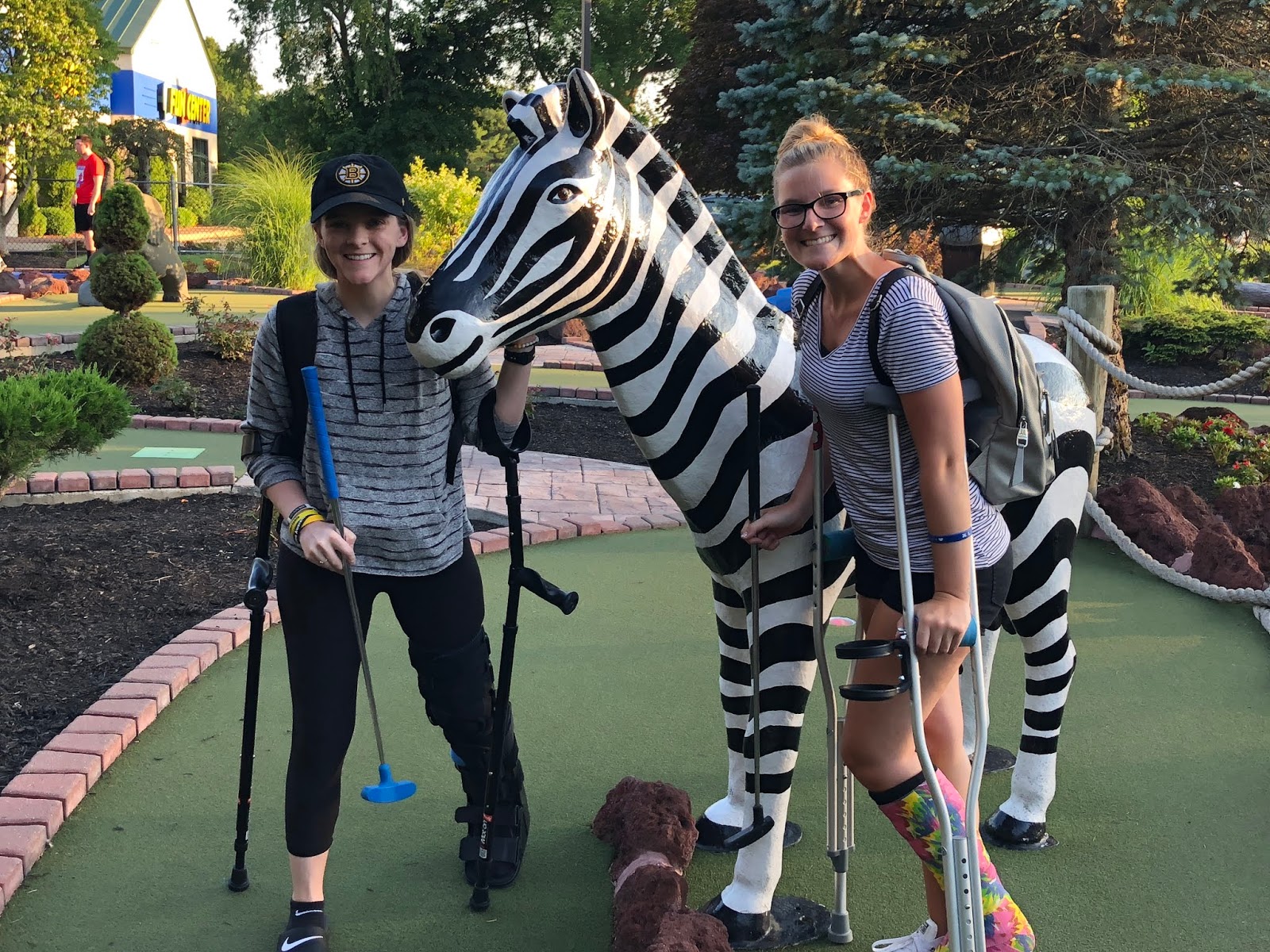
braces/splints to provide additional support, and use mobility aids regularly
(wheelchair and/or crutches). Though there is no perfect solution and
surgery is not a cure, sometimes we reach a point where my quality of life and
function with a particular joint is severely impacted and surgery is
the best option.
Dislocations: For me, the first step in
managing a dislocation is to reduce it (or relocate the joint back to its
"normal" position). Sometimes this is easy, and other times it just
does not seem to go back in correctly. Depending on the severity of the joint
dislocation, I either do nothing (after it is relocated), or I
brace/splint/immobilize the joint until the surrounding soft tissue has a
chance to settle down. Occasionally I require assistance from my PT to address
muscular imbalances that occur as a result of a dislocation/subluxation.
How will EDS affect you in the future?
It is difficult to predict how EDS will affect my future as both
EDS and chronic illness are truly unpredictable. I can't predict what my body
is going to do 10 minutes from now, so how can I predict my future? With that
said, EDS can be progressive. It has been for me. I have watched my health
decline over the last 4-5 years and I have not been able to regain any sense of
stability. So while I would welcome any improvement, realistically, with a
chronic and progressive disorder, it is unlikely that my health improves
significantly. This reality is stressful and overwhelming at times because it
makes planning my future even more challenging. I want to be able to support
myself and be independent. I want to be able to contribute to society in a
meaningful way. Unfortunately, with no ability to plan, I do not know what my
future will hold.
What is one thing you want someone without EDS to know about EDS
or how it impacts your life?
In a perfect world, friends and family (and the general public)
would understand everything. But that’s unrealistic. I think the ONE thing I
want someone without EDS to know about EDS/how it impacts my life is that it's
lifelong. EDS is a genetic condition. I was born with it. It is chronic and
progressive. It is not going away. I won’t wake up tomorrow and be better.
Surgery isn’t a cure. Physical therapy isn’t a cure. Bracing and splinting is
really just a band-aid. There is no medication that will fix this. There is NO
cure. The concept of chronic and progressive illnesses seems to baffle people.
They really struggle with the idea that there are health conditions that exist
without a starting point and an end.
There are so many things I wish people understood. It is not
possible to cover them all. It is also not realistic for me to expect people to
understand what it is like to live with chronic, unpredictable, progressive illnesses.
That is something that you only truly understand when you are living it. I am
blessed with family and friends who want to understand and for that, I am
forever grateful. Not everyone is as lucky to be surrounded by a wonderful
support system.
What is the hardest/worst part about having EDS?
I think the unpredictability of EDS and chronic illness is the
hardest part. Every day is different. I have very little control over what my
body does on any given day and that makes it very difficult to plan too far in
advance. I often feel guilty canceling plans last minute, and sometimes push
myself more than I should because of this guilt. For someone who likes to be in
control of situations, I have very little control.
What is the biggest lesson you have learned from EDS?
EDS has taught me so much. It has taught me how to adapt and how
to live despite my illness and altered reality. It has taught me to persevere
and to trust my instincts and fight for what I believe in. Everyday with EDS I
learn. I learn more about myself, my abilities, and my strengths.
My life with EDS and chronic illness is not the one I had
envisioned for myself. I had envisioned a life in Boston, working as a nurse at
my favorite hospital (the hospital that has done so much for me). I envisioned
pursuing a Master's in Case Management and/or Genetics to help others like
myself navigate a complicated system. I had hoped to make a positive difference
in people's lives. That is not my reality though. So the biggest lesson I have
learned is how to adapt to life's circumstances to redefine myself, my goals,
and my dreams.
How does EDS effect people with respect to their work life? Are
people with EDS able to manage to have jobs/careers?
EDS is a spectrum disorder. Some are only mildly affected, while
others are completely disabled. Some are able to work full-time with very
little difficulty. Others are able to work part-time. Yet, some may not
be able to work at all.
I am a Registered Nurse. I worked incredibly hard for my license;
however, unfortunately, I am unable to work at this time. I do volunteer as a
nurse at a barn that provides programs for special needs children. This allows
me to feel purposeful.
My health changes constantly. I live with unrelenting pain and
fatigue. In addition to EDS, I also have
Chiari Malformation, craniocervical instability, neurocardiogenic syncope
and POTS (autonomic dysfunction), gastroparesis and delayed intestinal
motility, Hashimoto's, Graves', autoimmune neutropenia, and complex regional pain
syndrome (CRPS). With the unpredictability of having so many
chronic illnesses, I never know how I am going to feel on a given day or week.
It is a frustrating reality, as I want nothing more than to be able to support
myself and contribute to society.
What aids do you use regularly? Do you need to use mobility aids
and braces consistently?
Due to joint dislocations, joint pain, fatigue, and autonomic
dysfunction (POTS) I use a variety of different mobility aids depending on my
situation. Sometimes I require a wheelchair for longer outings or circumstances
that would require me being on my feet for too long. Due to POTS, I cannot
stand for extended periods of time without pre-syncopal/syncopal (fainting)
episodes. I am also struggling with right hip dislocations/instability that
make weight bearing through my leg very difficult. I am a high fall risk as a
result, and a fall leads to other dislocations and injuries.
For shorter outings, I use forearm crutches. The challenge with
crutches, however, is that my right shoulder is incredibly unstable and often
dislocates when I apply too much weight through my arm. This can also lead to
falls, and with joints that don't stay in place, falls are less than
ideal.
 |
| My wheelchair allows me to do fun things with family and friends! |